Private sPEECH THERAPY VS SCHOOL SPEECH THERAPY
What Parents Should Know
By: Amanda Townsend
Where I Started (and Why This Matters to Me)
If you've ever sat in an IEP meeting and heard "your child doesn't qualify" while your gut is telling you something isn't clicking, I want you to know: you're not imagining it, and you're not alone.
I got my start in speech-language pathology working in the schools. I loved those kids, I loved my colleagues, and I learned so much about how communication shows up in the classroom, on the playground, and in the lunch line. I also learned firsthand how eligibility rules work, and how frustrating they can feel. Frustrating for parents, yes. But honestly? Frustrating for the SLPs too.
School-based SLPs are some of the hardest-working people I know. They juggle big caseloads, tight schedules, mountains of paperwork, and strict rules about who they're allowed to serve. They are doing the very best they can inside that system. So this post isn't about school vs. private. It's about understanding the differences so you can find the right mix of support for your child.
Why Your Child Might "Not Qualify" at School
Here's the big thing most families are never told: school eligibility and clinical need are not the same question.
Schools follow special education law (IDEA). To qualify for speech services in school, a team has to show two things: that your child has a communication difference and that it significantly impacts their ability to access their education. If your child is keeping up academically, they may not qualify, even if they're hard to understand at a birthday party, avoid talking to peers, or get frustrated trying to tell you about their day.
Private therapy asks a different question: Would this child benefit from support with their communication? We look at the whole child: home, play, friendships, confidence, and everyday life, not just the classroom.
So "didn't qualify" doesn't mean "doesn't need help." It often just means "doesn't meet the school's specific criteria."
5 Ways School and Private Speech Are Different
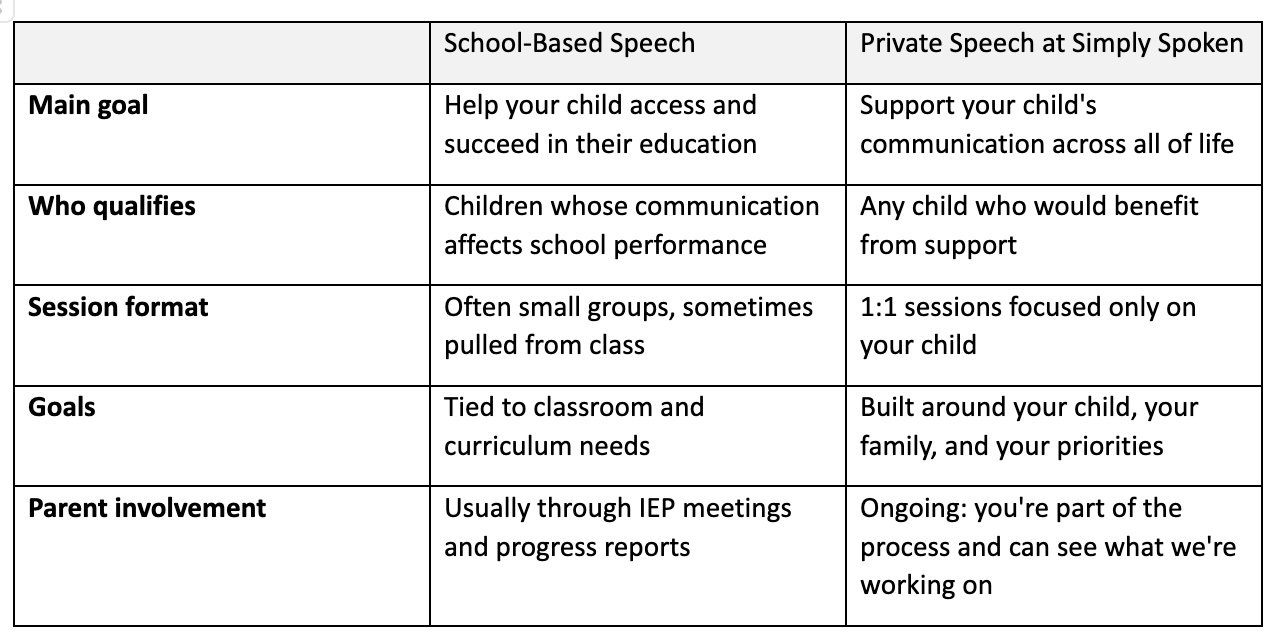
1. The goal is different. School SLPs focus on what your child needs to participate at school. In private therapy, we can work on anything that matters to your child's communication, like ordering at a restaurant, playing with a sibling, or telling Grandma a story.
2. Eligibility is different. As above, schools have legal criteria to meet. Private practice doesn't require a child to be "behind enough" to get help.
3. The format is different. Group sessions in school can be wonderful for practicing with peers. Private 1:1 sessions give your child focused, individualized time and lots of practice opportunities.
4. The approach can be different. At Simply Spoken, we're play-based and neurodiversity-affirming. We follow your child's interests and build on their strengths, so therapy feels like connection, not compliance.
5. Families are in the room (literally and figuratively). Private therapy makes it easier to share strategies you can use at home, so progress keeps happening between sessions.
Already Have an IEP? Private Speech Can Be a Great Teammate
If your child receives speech at school, private therapy isn't a replacement. It's a boost. Think of it like a kid who plays on the school soccer team and takes a few private lessons. More practice, more support, more progress.
Adding 1:1 private sessions can help your child:
Get more total practice time each week
Work on goals outside the IEP, like social communication or play skills
Carry new skills from school into home and community settings
Build confidence in a calm, focused, one-on-one space
With your permission, we're always happy to connect with your child's school SLP. When everyone is on the same team, kids win.
Didn't Qualify at School? You Still Have Options
If you left that meeting feeling dismissed or confused, please hear this: your concerns are valid, and your child can still get support.
Signs that private speech might be helpful, even without school eligibility:
Strangers or teachers have a hard time understanding your child
Your child gets frustrated, shuts down, or melts down when they can't get their message across
They have trouble joining play, taking turns in conversation, or connecting with peers
They're using fewer words than other kids their age
They stutter or seem to work hard to get words out
Your gut keeps telling you something is going on
Early support makes a real difference, and you don't need to wait until things get "bad enough" to start.
Quick Answers for Busy Parents
Can my child get speech at school and privately at the same time? Yes! Many of our families do both.
Do I need a referral or a school evaluation first? No. You can reach out to us directly.
What if my child is "only a little behind"? That's a great time to start. Small concerns are easier to support early.
Will private therapy conflict with what the school is doing? Not at all. We're happy to collaborate so everyone is working toward the same goals.
Let's Talk About Your Child
Whether your child has an active IEP, was just told they don't qualify, or you're simply wondering if something is off, we'd love to hear from you. At Simply Spoken, therapy is play-based, neurodiversity-affirming, and built around your child.
Reach out today to get on our list:
Visit: 6125 Green Bay Rd #800, Kenosha, WI 53142
Website: Complete our Contact Form
Know a parent who's been told "they don't qualify"? Share this post. It might be exactly what they need to hear today.